LibraryDocuments
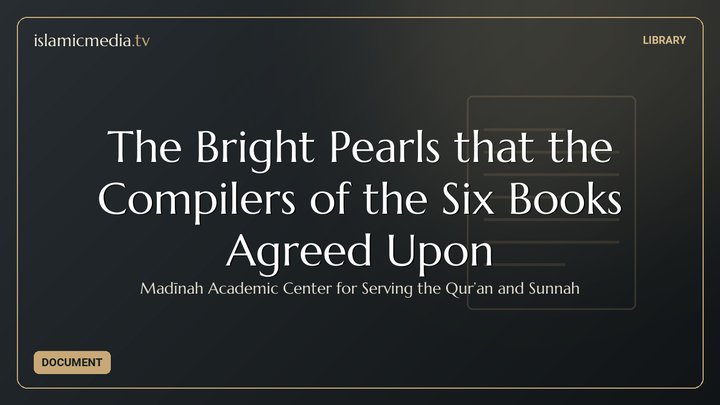
The Bright Pearls that the Compilers of the Six Books Agreed Upon
The Bright Pearls that the Compilers of the Six Books Agreed Upon By: Madīnah Academic Center for Serving the Qur’an and Sunnah Source: IslamHouse.com · Madīnah Academic Center for Serving the Qur’an and Sunnah
Extrait du livre
Les premières pages du texte. Ouvrez le livre ci-dessus pour le lire en entier.
The Bright Pearls that the Compilers of
the Six Books Agreed Upon
Madīnah Academic Center for Serving the Qur’an and Sunnah
Published by Tahdhīb Channel
Introduction
In the name of Allah, the Most Compassionate, the Most Merciful.
All praise is due to Allah; we praise Him and seek His help and forgiveness.
We seek refuge with Allah from the evil of our selves and from our bad deeds.
Whoever Allah guides, none can lead astray, and whoever He leads astray, none can guide.
I bear witness that none is worthy of worship but Allah, and I bear witness that Muhammad is His slave
and messenger.
To proceed:
The Sunnah is the second source of legislation in Islam, and it is unanimously regarded by Muslims as
an independent source.
The Sunnah and Qur’an are correlated and inseparable.
The Qur’an cannot be properly understood and cannot provide its ultimate benefit without the Sunnah.
The Sunnah is a guardian of the Qur’an; were it not for the Sunnah, anyone could say whatever he liked
about the Qur’an.
Out of His favor upon this Ummah, Allah Almighty endowed it with distinguished figures and select elite,
at its early stage, who devoted themselves to serving the pure Sunnah. They gathered it directly from
those who heard it and collected it from those who memorized it. To this end, they expended their
wealth and lifetime. Thanks to their great effort, we have many huge books that comprise the legacy of
our Prophet (may Allah’s peace and blessings be upon him). It is because of this that they merit the
pleasure of Allah Almighty and deserve gratitude and honor.
Those widely renowned books include the following:
Al-Jāmi‘ Al-Sahīh by Al-Bukhāri
Al-Jāmi‘ Al-Sahīh by Muslim
Jāmi‘ Al-Tirmidhi
Sunan Abu Dāwūd
Sunan Al-Nasā’i
Sunan Ibn Mājah
Muslim scholars devoted attention to the books of Sunnah in general and to those Six Books in
particular: Al-Bukhāri, Muslim, Abu Dāwūd, Al-Tirmidhi, Al-Nasā’i, and Ibn Mājah. They gave
extraordinary attention to these books, in terms of their chains of transmission and texts. So, they
memorized, verified, arranged, abridged, and commented on these important compilations.
As another manifestation of this interest, scholars compiled the Hadīths whose Takhrīj (verification and
authentication) is subject to agreement among the compilers of the Six Books. The first to undertake
such a great endeavor was Imam Ibn al-Athīr (d. 606 AH) (may Allah have mercy upon him)
in his book Jāmi‘ Al-Usūl fi Ahādīth Al-Rasūl. However, he counted Al-Muwatta’ for Imam Mālik
among the Six Books, following the approach of the earlier scholars. Latter scholars of Hadīth, on the
other hand, replaced Al-Muwatta’ with Sunan Ibn Mājah, something which became common and
traditional among scholars.
Scholars who wrote on this topic include Imam Al-Hāfizh ‘Alā’ al-Dīn Maghlatāy (d. 762 AH). He
authored a book titled Al-Durar Al-Manzhūm min Kalām Al-Mustafa Al-Ma‘sūm. However, he only cited
the Hadīths on Islamic rulings and excluded other Hadīths.
Among the contemporary scholars is Dr. ‘Awwād al-Khalaf, who penned a book titled Sahīh Al-Huffāzh
mimma Ittafaqa ‘alayhi Al-A’immah Al-Sittah. But he did not follow the traditional way of counting the
Hadīths.
For example, if a Hadīth is reported by a certain Companion and narrated in only four of the Six Books,
and another version of the Hadīth is reported by another Companion and narrated in two of the Six
Books, in such a case the scholars of Hadīth do not consider this Hadīth one of the Hadīths whose
Takhrīj is subject to agreement among the compilers of the Six Books; rather, they deem it two separate
Hadīths. Dr. ‘Awwād, on the other hand, regards the two Hadīths as one and counts it among the
Hadīths whose Takhrīj is subject to agreement among the compilers of the Six Books.
Hence, there was still a need for compiling a book that comprises the Hadīths whose Takhrīj is agreed
upon among the compilers of the Six Books, taking into consideration the methodology adopted by the
scholars of Hadīth.
It is a favor from Allah that He enabled us to contribute to this great work under the auspices of Madīnah
Academic Center for Serving the Qur'an and Sunnah by writing this book, which we called Al-La’āli’ Al-
Mudī’ah fima Ittafaqa ‘alayhi As-hāb Al-Kutub Al-Sittah.
The Book Methodology:
In this book, we have adopted the following methodology:
1. We include in this book the Hadīths for which the compilers of the Six Books made Takhrīj via one
Companion. If there are two Companions, even if the Hadīth’s wording is the same, we deem it as two
Hadīths as per the rule established among the scholars of Hadīth.
An example is a Hadīth reported by Anas who said:
“The Prophet (may Allah’s peace and blessings be upon him) forbade using animals as targets.”
The Hadīth, as reported by Anas, is narrated in the Six Books, except for Al-Tirmidhi who narrated it
through Abu al-Dardā’. Therefore, we did not include it in this book.
2. The Hadīths are arranged by topic in accordance with the order adopted in Sahīh Muslim, for it is the
best book in terms of arrangement.
3. The wordings included in the book are those narrated by Al-Bukhāri, given his great care in this
regard.
4. We only mention the name of the Companion in a chain of transmission for the sake of brevity. And
we may also mention the name of the succeeding Tābi‘i (one who met a Companion and died as a
Muslim),
if contextually needed.
We have greatly benefited from the book Al-Lu’lu’ wa Al-Marjān by Shaykh Fu’ād ‘Abd al-Bāqi, for he
compiled therein the Hadīths on which both Al-Bukhāri and Muslim agreed on its Takhrīj.
Nonetheless, we corrected the author with regard to some Hadīths, which he did not include in his book.
Benefits of this book:
1. We compiled in this book the Hadīths whose original versions were subject to Takhrīj by the famous
Six Compilers of Hadīth, namely Al-Bukhāri, Muslim, Abu Dāwūd, Al-Tirmidhi, Al-Nasā’i, and Ibn Mājah.
Indeed, these are the most authentic among the Prophet’s reported statements.
2. Undoubtedly, whoever wants to memorize the Six Books should first begin with the Hadīths agreed
upon among those six scholars, and then memorize the Hadīths agreed upon between Al-Bukhāri and
Muslim, then the Hadīths narrated by Al-Bukhāri alone, then the Hadīths narrated by Muslim alone, and
then the additional Hadīths narrated by each of the four Imams and that agree with the conditions of
both Al-Bukhāri and Muslim or one of them.
3. The book is short and easy to read, use, and benefit from.
Commentaires
Aucun commentaire pour l'instant. Soyez le premier à partager une réflexion utile.
À voir aussi
 ▤Document
عظماء في التاريخ
islamicmedia.tv
1 view · 9 hours ago
 ▤Document
من أحكام صلاة المرأة في الحرمين
islamicmedia.tv
1 view · 9 hours ago
 ▤Document
البرنامج اليومي للمسلمة في شهر رمضان
islamicmedia.tv
1 view · 9 hours ago
 ▤Document
أحكام المرأة في الصلاة دراسة فقهية مقارنة
islamicmedia.tv
1 view · 9 hours ago
 ▤Document
توحيد الألوهية أساس الإسلام
islamicmedia.tv
1 view · 9 hours ago
 ▤Document
شرح رسالة القواعد الأربع
islamicmedia.tv
1 view · 9 hours ago
 ▤Document
توحيد الرب
islamicmedia.tv
1 view · 9 hours ago
 ▤Document
شرح خطبة الحاجة
islamicmedia.tv
1 view · 9 hours ago
 ▤Document
إِلاَّ لِيَعْبُدُونِ - كيف يوحد القرآن وجهة الإنسان؟
islamicmedia.tv
1 view · 9 hours ago
 ▤Document
Resumo do livro Seleção de Hadiths Proféticos
islamicmedia.tv
1 view · 1 day ago